For most importers of bags, FOB Shanghai or Ningbo with your own forwarder is the right default: you control the freight rate, you see the real cost, and the supplier's responsibility ends at a clearly defined point. CIF suits first-time or low-volume buyers who want one invoice; DDP suits buyers with no import infrastructure but hides the duty line. Because bags are light and bulky, ocean freight is priced by volume, not weight — carton efficiency usually moves landed cost more than a 2% negotiation on unit price.
Bags are the classic light, bulky cargo. That single fact should shape how you buy freight.
Volume, not weight
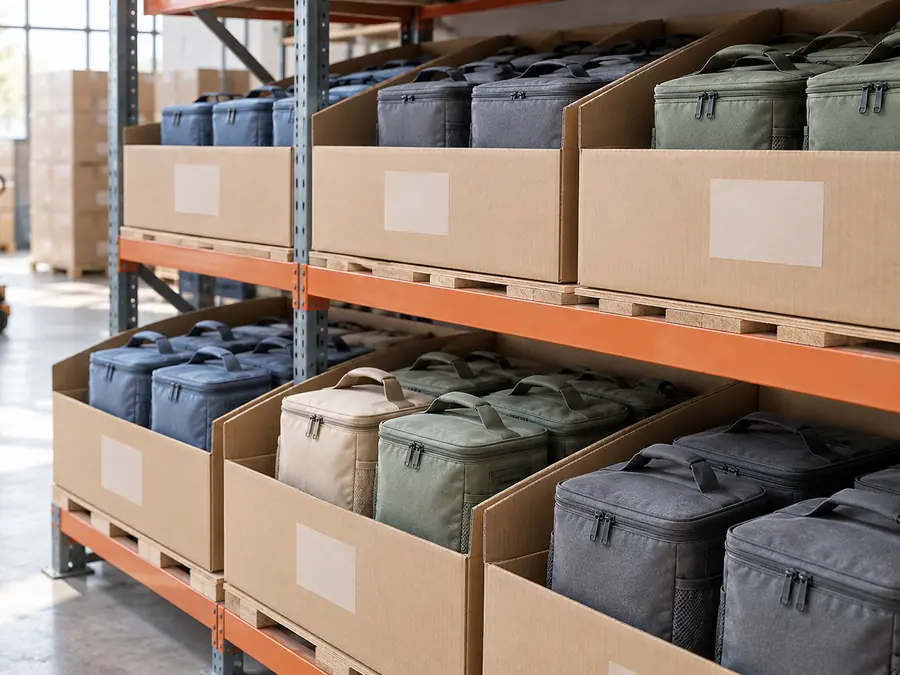
Ocean and air freight both price on the greater of actual weight and volumetric weight. A carton of 24 folded cooler bags might weigh 11 kg and occupy 0.053 CBM. Nobody is paying for those 11 kg — you are paying for the cubic metres.
Two consequences:
- Carton efficiency is a price lever. Ask every supplier for pieces per carton and carton dimensions in the quotation. A supplier who packs 30 to a carton where another packs 24 is 20% cheaper on freight for the same goods.
- Compression is worth money. Vacuum or compression packing on padded goods can cut CBM by 15–30%. It costs a little at the factory and it changes the landed number.
Incoterms in plain language
| Term | Supplier's cost stops at | You handle | Best for |
|---|---|---|---|
| EXW | Factory door | Everything: inland trucking, export clearance, port charges, freight, import | Buyers with a China agent |
| FOB | Goods loaded on the vessel at the named port | Ocean freight, insurance, import clearance, duty, delivery | Most importers |
| CIF | Destination port, freight and insurance paid | Import clearance, duty, destination charges, delivery | First orders, low volume |
| DDP | Your door, duties paid | Nothing | Buyers with no import setup |
Two warnings from experience:
- EXW looks cheapest and rarely is. Chinese export clearance under EXW is awkward for the buyer and the inland leg is quoted separately.
- Under supplier-nominated CIF, watch the destination charges. The freight saving can be recovered by the destination agent in handling fees you did not see coming. If you take CIF, ask for the destination charge schedule before you agree.
We quote FOB Shanghai or Ningbo by default, and we are happy to work with your nominated forwarder — most of our repeat customers do exactly that.
Consolidation: one shipment, several models
If you are buying a range — say three cooler models, a backpack and a cosmetic pouch — the temptation is to source each from its cheapest specialist. Then you have five suppliers, five sets of documents, five inspection visits, and either five LCL shipments or a consolidation warehouse bill.
This is the one place where buying through a single export desk clearly wins. We consolidate multiple models into one shipment under one invoice, one packing list, one certificate of origin and one bill of lading, at no extra handling charge. On a mixed range that saving typically exceeds the unit-price premium.
The calendar out of China
| Period | What happens |
|---|---|
| Mid-Jan to late Feb | Chinese New Year. Factories close 2–3 weeks; the fortnight before is a scramble and the fortnight after is a slow restart. |
| March to June | The easiest window. Capacity available, rates soft. |
| Aug to Oct | Peak. Christmas cargo moves; container space and factory capacity both tighten; rates rise. |
| Early Oct | Golden Week — one week of national holiday. |
| Nov to Dec | Normalising, good time to develop next season. |
If your goods must be on shelf in November, the container should leave in early September at the latest for Europe, which means production finishes in late August, which means the order is placed in June and the sample was approved in May.
Documents you should expect
- Commercial invoice and packing list
- Bill of lading (or telex release)
- Certificate of origin — Form A, CO, or FTA-specific forms where a preferential rate applies
- Fumigation or heat-treatment certificate if wooden pallets are used (ISPM 15)
- Test reports and compliance declarations, issued in your entity's name
- GRS transaction certificate for recycled-content claims
Ask for draft documents before the vessel sails. A wrong consignee name on a bill of lading is a two-week problem at destination and a five-minute problem before it is issued.
Getting a landed-cost number
Send us a model, a quantity and a destination port and we will return FOB, an indicative freight figure from a forwarder we work with, and the carton data so your own broker can finish the calculation. Start here.
Frequently asked
FOB or CIF — which is cheaper?
FOB is almost always cheaper in total, because you buy freight at your own negotiated rate instead of the supplier's marked-up one, and because destination charges under a supplier-nominated CIF booking are frequently higher than the freight you saved. CIF is simpler, and simplicity has value on a first order.
LCL or FCL for a 3,000-piece order?
Work out the CBM. A folded 24-can cooler runs roughly 0.0022 CBM per piece packed, so 3,000 pieces is about 6.6 CBM — comfortably LCL. A 20 ft container holds about 28 CBM usable and a 40 HQ about 68 CBM. LCL becomes uneconomic above roughly 15 CBM, where a 20 ft container usually wins.
How long does it take to reach my port?
From Shanghai: 28–35 days to US East Coast, 18–24 days to US West Coast, 30–40 days to North European base ports, 20–26 days to the Mediterranean, 14–18 days to Australia, 5–8 days to Japan and Korea. Add 5–10 days for LCL deconsolidation, and add contingency in September and October.