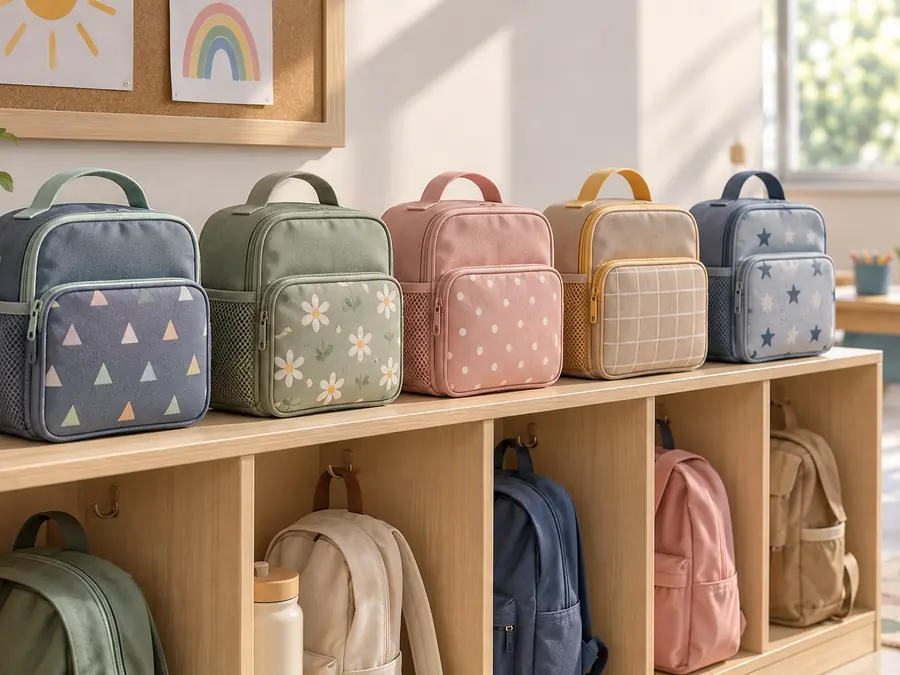
A good kids lunch bag is sized to the child's containers, light enough to carry, easy to open and wipe clean, and insulated well enough to last from breakfast to lunch. Roughly 3–5 litres suits toddlers, 5–9 litres suits primary school and 9–14 litres suits teens. For retail, plan EN 71-3, phthalate, CPSIA and food-contact tests per market.
The best kids lunch box is the one a child can open by themselves, that fits the containers their parents already own and that still feels cool when the lunch bell rings. Parents searching for a toddler lunch box or a kids lunch bag are asking practical questions about size, cleaning and cold holding; retailers and brand owners selling lunch bags for kids need the same answers plus a test plan. This guide from the Eggroll Bags export desk covers sizes by age, the features that drive repeat purchase, the insulation that gets a packed lunch to midday, and the testing a children's lunch bag needs.
What size kids lunch bag do you need?
Size the bag to the containers it has to hold, then to the child. A toddler needs a small, light bag for a snack pot and a drink; a primary-age child needs room for a bento box and a bottle; teenagers eat more and often need a lunch bag that holds two or three containers.
| Age group | Typical capacity | Usually holds | Design priorities |
|---|---|---|---|
| Toddler and nursery (2–4) | About 3–5 L | Snack pot, small sandwich box, small drink | Light weight, large zip puller, short grab handle, name label |
| Kindergarten and early primary (4–7) | About 5–7 L | Bento box, drink bottle, fruit | Opens flat, wipe-clean lining, easy closure |
| Primary school (7–11) | About 6–9 L | Bento or two containers, bottle, snack | Durable outer, bottle pocket, shoulder strap option |
| Teens (12+) | About 9–14 L | Two or three containers, large bottle | Plain or grown-up styling, adult-like proportions |
To read a catalogue size as capacity, multiply the external dimensions and divide by 1,000. Our kids cooler bag for school (600D polyester, 19×14×24 cm) is about 6.4 litres external, a natural fit for kindergarten and early primary. The kids lunch cooler bag (600D with microfiber, 24.5×16.5×22.5 cm) is about 9.1 litres for older children. For lunch boxes for teens, the teenagers' lunch box bag for school (600D polyester with PEVA, 32×12×35 cm) is about 13.4 litres. Internal volume is lower once the foam wall is allowed for.
The quickest way to get size right is to put the bento boxes and bottles your customers actually buy on the table and build the base around them. A metal bento box for kids is often rigid and heavy for its size, so a bag designed around one needs a firm base panel and a slightly wider opening.
What makes the best kids lunch box for school?
Parents choose with their hands: the bag that opens easily, cleans in a minute and survives the school bag gets bought again. Character prints and colours sell the first purchase; function sells the second.
- Easy opening. A large zip puller or a wide opening a small child can manage alone. Wrap-around zips that open the bag flat make packing and cleaning easier.
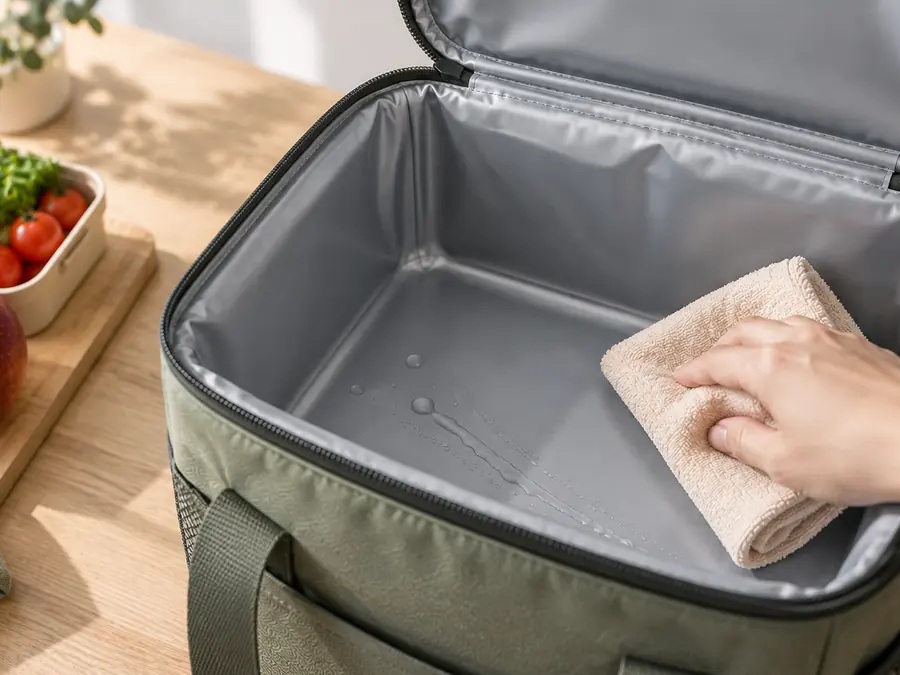
- Wipe-clean lining. A smooth PEVA or similar lining with welded or taped seams so spills do not soak into the foam.
- Name space. A clear label window or a printed panel for a name; schools are full of identical bags.
- Light weight. The bag should weigh little compared with its contents, especially for nursery children.
- Carry options. A grab handle for little ones; a detachable shoulder strap or a clip-on loop to fix it to a school backpack for older children.
- Bottle pocket. Girls and boys lunch box searches often add "with water bottle"; an outside mesh or insulated pocket answers that.
Styling splits by age more than by gender. Bright prints, animals and shaped bags work for toddlers and early primary; by the end of primary school many children want plainer colours, and teenage girls and boys often prefer something that looks like an adult lunch bag. Snack bags for kids, small zip pouches for fruit or crackers, are a useful add-on in the same print.
How long does an insulated lunch box for kids keep food cold?
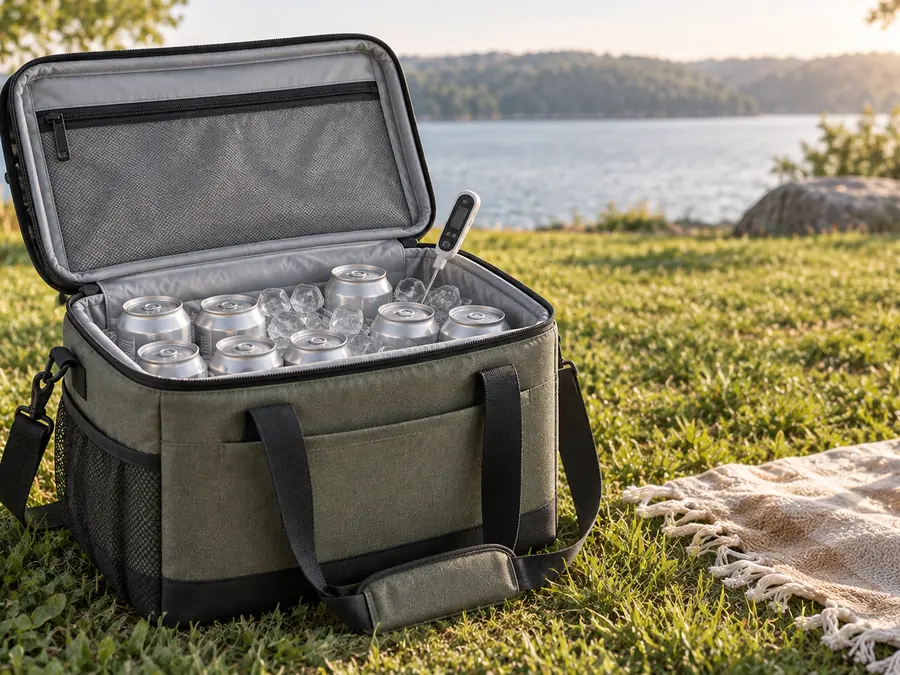
A well-built insulated lunch bag with gel packs should comfortably cover a school morning, which is typically four to five hours from packing to lunch. Thinner, softer bags hold temperature for less time.
Our published design data: a 10 mm EPE foam wall with a welded leak-proof liner and two gel packs holds refrigerated food below 8 °C for roughly 6–8 hours at 25 °C ambient. Thicker 15–20 mm walls, a zip storm flap and a light outer colour extend that. These are design ranges, not guarantees; a bag left in a sunny classroom or on a hot bus will do worse.
Many children's lunch bags use thinner foam to keep them small and light, which shortens hold time. If the packaging will make a cold-holding claim, we can run a timed temperature test on the approved sample so the number you print is one you can support. Parents get the most from any bag by chilling the food overnight and using at least one gel pack.
Which safety tests apply to children's lunch bags?
A children's lunch bag is tested to the rules for both children's products and food-contact materials in the market where it is sold. We describe what testing applies; we do not describe any bag as "safe".
| Test or report | What it covers | Typical market |
|---|---|---|
| EN 71-3 | Migration of certain elements from accessible materials in children's products | EU, UK |
| Phthalates | Restricted plasticisers in PVC, prints and coated parts | EU, UK, US |
| CPSIA | US requirements for children's products, including lead and phthalate limits | US |
| Food-contact migration | Substances moving from the liner into food | EU, UK, US |
| REACH SVHC | Substances of very high concern in fabric and components | EU |
| Prop 65 | Listed chemicals that trigger a warning in California | US (California) |
Reports are issued per model and per market in the buyer's name, which is what retailer onboarding portals expect. For products aimed at the youngest children, also review small parts such as detachable decorations and zip pullers, and avoid long cords. Labelling, warnings and age grading are covered in our guide to private-label lunch bags for retail; confirm the final requirements with your own compliance team.
Backpack and lunchbox sets
A matching backpack and lunch box set is one of the strongest back-to-school formats, because it is an easy gift and a single shelf position. The trick is to design both pieces together so the lunch bag fits inside or clips to the backpack.
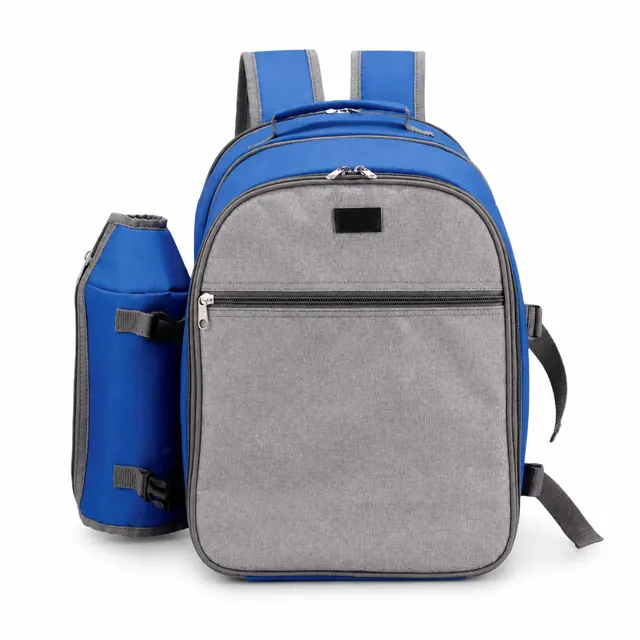
Agree a shared print, colour and trim from the start so the fabric is bought in one run and the colours match. A children's backpack and lunch box set can also include a pencil case or snack pouch in the same pattern. The children's cooler picnic backpack (27×21×38 cm) is one starting point for an insulated, toddler-sized pack. Our back-to-school backpacks and lunch kits project shows how a coordinated range was planned across backpacks, lunch kits and pencil cases.
How to source kids lunch bags for retail
Start from a tooled catalogue model, change the print and trims, and book testing early. That is the fastest route to a school-season shelf date.
- Fix the age group and the containers the bag must hold.
- Shortlist two or three models from the insulated lunch bag range.
- Send artwork for prints, with Pantone TCX or TPG references for fabric and Pantone C for print.
- Approve a counter sample (7–12 days; the fee is credited against bulk), opening and closing it as a child would.
- Book the tests for each market as soon as materials are confirmed.
- Agree the pre-shipment inspection: ISO 2859-1 General Level II, AQL 2.5 major and 4.0 minor, with zip cycle, liner leak (1 litre of water for 10 minutes) and print rub tests.
Minimums are 500 pieces per colour on a catalogue model and 1,000 pieces per colour for a new pattern or custom-dyed colour; trial runs of 100–300 pieces are sometimes possible on lunch bags at a higher unit price. Bulk takes 25–35 days after sample approval, and July to October adds about a week, so back-to-school orders are best placed in winter or early spring. When you are ready, send us your brief for a quote.
Frequently asked
What size lunch box does a kindergarten child need?
Most kindergarten children need a lunch bag of about 5–7 litres, enough for a bento box, a drink bottle and a piece of fruit. More important than volume is fit: the bag should hold the containers the family already uses, open wide enough for small hands and be light enough for a young child to carry alone.
Are insulated lunch bags good for kids?
Yes, for anything perishable. An insulated lunch bag with a sealed lining and a gel pack slows warming through the school morning. A 10 mm foam wall with two gel packs is designed to hold chilled food below 8 °C for roughly 6–8 hours at 25 °C, though slimmer children's bags hold for less time.
How do I clean a kids lunch bag?
Wipe the lining with warm, soapy water after each use and leave the bag open to dry. A smooth lining with sealed seams stops spills reaching the foam, which is where smells build up. Follow the care label for the outer fabric; many insulated bags should not go in a washing machine because it can damage the foam.
What tests does a children's lunch bag need?
It depends on the market. Typical reports include EN 71-3 and phthalates for the EU and UK, CPSIA for the US, a food-contact migration test on the liner and REACH or Prop 65 where relevant. Reports should be issued per model and market in the importer's name. Confirm the final list with your compliance team.
What is the minimum order for custom kids lunch bags?
For a catalogue model the minimum is 500 pieces per colour, and 1,000 pieces per colour for a new pattern or custom-dyed colour. Trial runs of 100–300 pieces are sometimes possible on lunch bags at a higher unit price, which helps when testing a new character or print before a full school-season order.