A soft cooler bag with a 10 mm EPE foam wall, a welded leak-proof liner and two gel packs keeps refrigerated food below 8 °C for roughly 6–8 hours at 25 °C ambient. Thicker 15–20 mm walls, more ice, a storm flap over the zip and a light outer colour extend that. Treat any hold time as a design range and confirm it with a timed test.
Soft coolers with ice are sold on one promise: the food at the bottom is still cold when the bag is opened. How long that promise holds is not a property of the brand or the price tag. It is the result of four things you can specify — wall thickness, liner construction, closure and the amount of ice or gel inside — plus one you cannot: the weather. This guide sets out realistic hold times by construction, what actually makes insulated bags to keep food cold perform, and how to write a specification your supplier can be held to.
How long does a cooler bag keep ice and food cold?
A well-built soft cooler with a 10 mm foam wall, a welded leak-proof liner and two gel packs keeps refrigerated food below 8 °C for roughly 6–8 hours at 25 °C ambient. Thinner walls give less; thicker walls, a storm flap and more ice give more.
That figure is the design data our export desk publishes for our own standard construction, and it is a range, not a guarantee. It assumes the food goes in already chilled, the bag starts at room temperature, and the lid stays closed most of the day. Put warm drinks in, open the bag every twenty minutes or leave it on a sunny car seat, and the hours shrink quickly.
Why 8 °C? It is a common working ceiling for chilled food in food-safety guidance, and many markets use a lower figure (around 4–5 °C) for refrigerators. A cooler bag cannot refrigerate; it can only slow the rate at which chilled food warms up. Anything the buyer promises on the swing tag should be framed that way.
What determines how long a soft cooler stays cold
Insulation thickness and the amount of cold you put in matter most; everything else either protects or wastes that cold.
- Wall thickness and foam type. Closed-cell EPE foam is the workhorse. Doubling the wall roughly halves the conducted heat through the panels, which is why 15–20 mm walls are the step-up for all-day picnic and beach coolers. Our cooler bag insulation guide compares PEVA, TPU, foil and foam layers in detail.
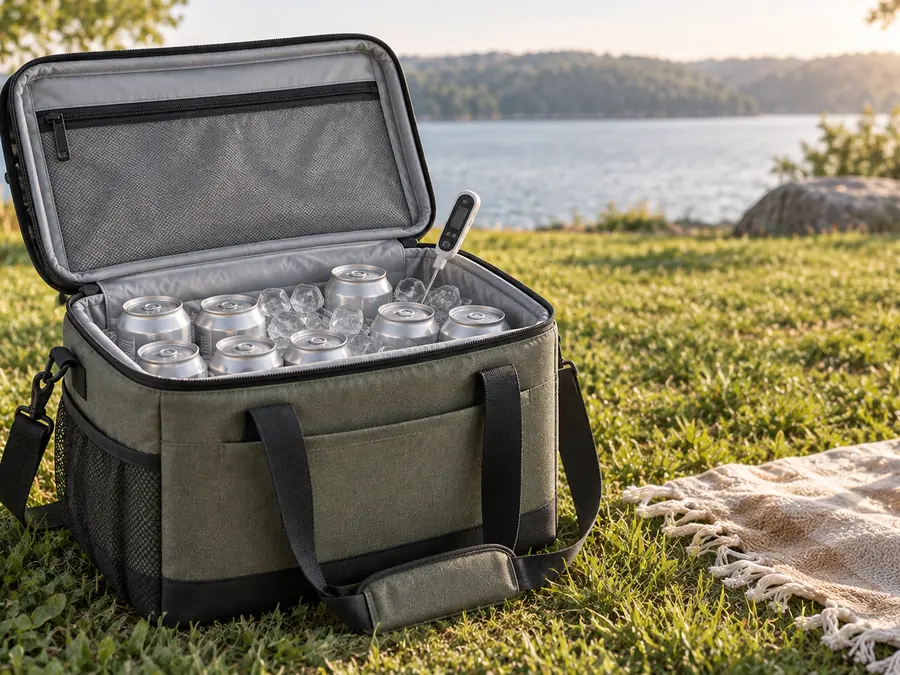
- The cold source. Ice packs to keep food cold are the engine of the system. Melting ice absorbs a large amount of heat (about 334 joules per gram) without its own temperature rising, so more ice mass means more hours. A half-empty bag with one small gel pack will not perform like the test sample.
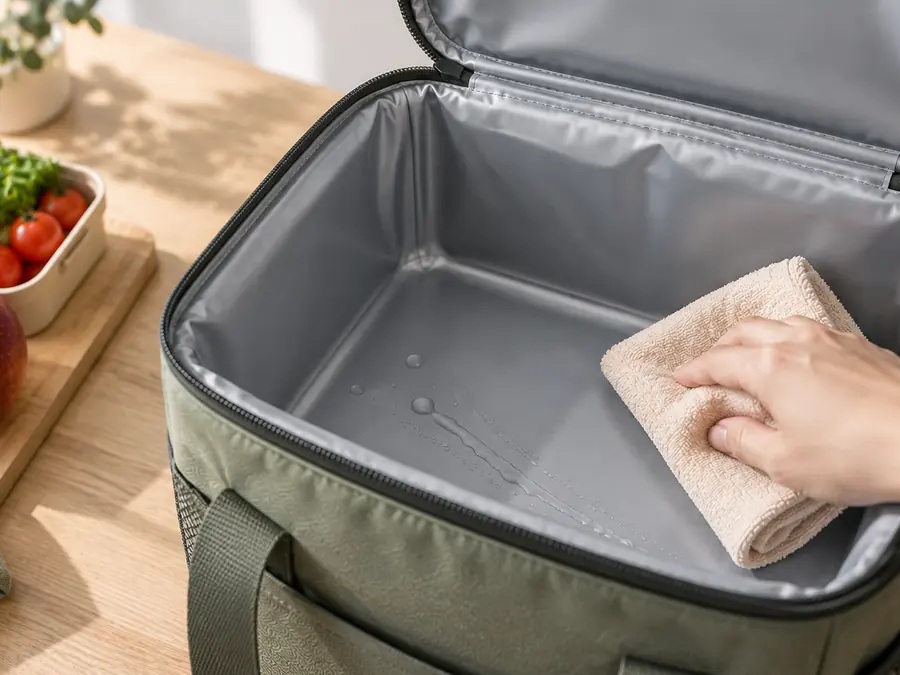
- Liner and seams. A welded (heat-sealed) liner stops meltwater soaking into the foam. Wet foam conducts heat far better than dry foam, and a stitched liner that leaks will quietly degrade the bag after a few uses.
- Closure. The zip is the weakest line in the wall. A storm flap over the zip, or a zip that runs down into an insulated lid rather than across bare fabric, closes the gap.
- Outer colour and fabric. A light outer colour reflects more sunlight. On a beach or a dashboard this makes a visible difference; in a shaded office it barely matters.
- Fill ratio and opening frequency. A full bag has less air to warm and swap out each time it is opened.
Hold times by construction: what to expect
Use the table below to match a construction to a use. Only the first standard row is our published data point; the others are relative and should be confirmed with a timed test on your approved sample.
| Construction | Typical use | Expected hold, chilled food at 25 °C ambient | Notes |
|---|---|---|---|
| Foil or PEVA liner, thin foam (3–5 mm) | Snack bags, promotional giveaways | Noticeably shorter than the 10 mm standard; a commute and a morning | Light and cheap; best with one gel pack and a short day |
| 10 mm EPE foam, welded liner, two gel packs | Lunch bags, office meal bags | Roughly 6–8 hours (published design range) | Our standard construction for adult lunch bags |
| 15–20 mm EPE foam, welded liner, storm flap | Picnic coolers, beach and fishing bags | Longer than the 10 mm standard; extended by more ice and a light outer | Bulkier; check carton volume and freight |
| Thick-wall cooler with 1680D/600D PVC outer | All-day outdoor use | Longest of the soft constructions here, on a timed test | Heavier, stiffer, premium handfeel |
| 12 V electric cooler bag | Car and road trips | Not ice-dependent while powered | Performance depends on the cooling unit and the vehicle supply |
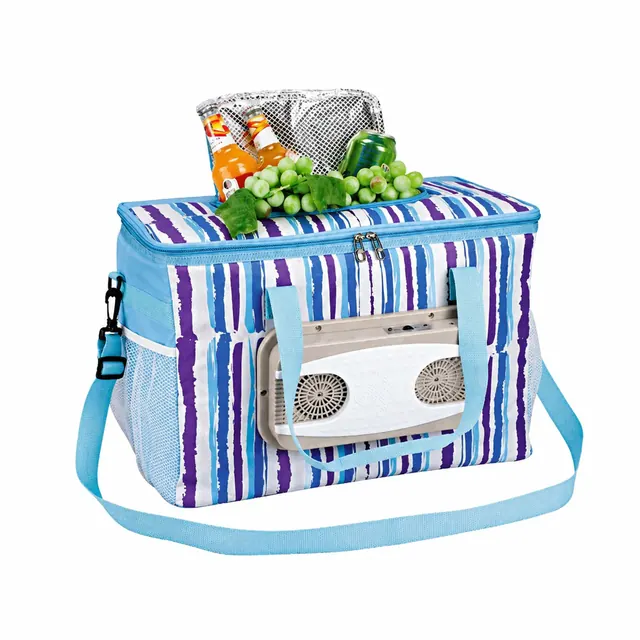
For an all-day product, start from a thick-wall model such as our 33 × 21 × 40 cm picnic cooler in 1680D/600D PVC. If the bag lives in a car, a powered option like the 47 × 28 × 32 cm electric car cooler bag removes the ice question altogether while it is plugged in.
Best lunch boxes to keep food cold: what to look for
The best lunchbox to keep food cold is a soft insulated bag with a welded liner, a foam wall of around 10 mm, room for at least one gel pack against the food, and a closure that seals well. Shape and print are secondary.
Consumers searching for the best lunch boxes to keep food cold usually mean a lunch bag that carries containers, not the container itself. For a range buyer, that changes the brief:
- Size the bag around real contents: two standard food containers, a drink and a gel pack, with no large air gap.
- Place a gel-pack pocket or sleeve in the lid or against a wall, so the cold source touches the food rather than floating on top.
- Keep the liner wipe-clean and seam-sealed; parents and office workers judge a lunch bag on smell after a month.
- Add a front pocket outside the insulated zone for cutlery and phones, so the main compartment is opened less.
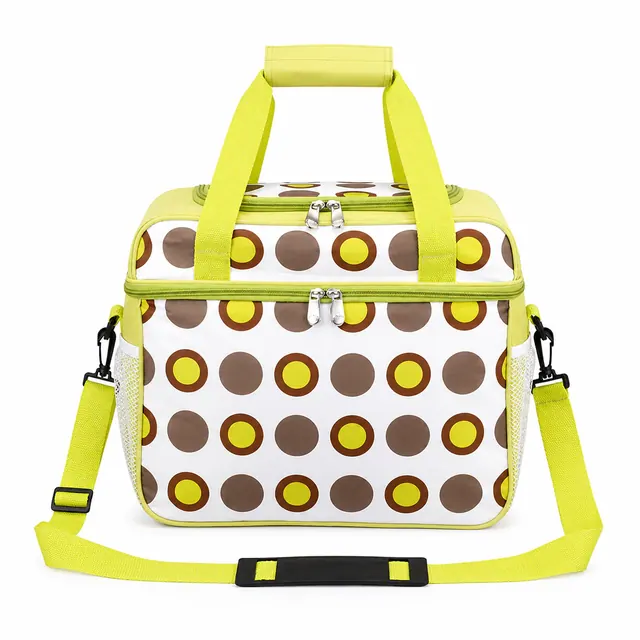
Our 35 × 20 × 29 cm lunch bag with shoulder strap in 600D polyester and PEVA is a typical adult format; the full range sits in insulated lunch bags.
Ice packs, gel packs or loose ice: which keeps food cold longest?
For food, frozen gel packs are the practical choice: they stay contained, do not soak packaging and can be refrozen. Loose ice gives more cooling per kilogram of bag space when drinks are the cargo, but only in a fully welded liner.
A few rules hold regardless of the container to keep food cold:
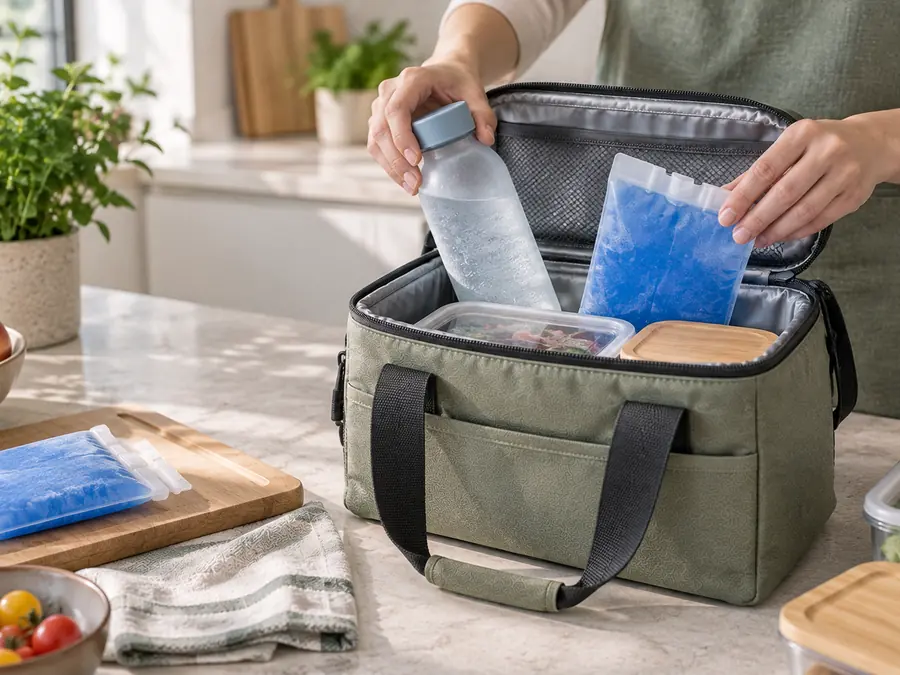
- Pre-chill the bag. Twenty minutes with a gel pack inside removes the heat stored in the liner and foam.
- Pack food cold from the fridge, never at room temperature.
- Put the cold source on top as well as underneath; cold air sinks.
- Fill the gaps. A frozen water bottle doubles as a drink later.
- Keep the bag out of direct sun and off hot car floors.
We do not sell ice packs as a standalone product. If gel packs are part of your retail set, tell us the size and quantity in your brief and we will design the pocket around them.
How to specify and test hold time with a supplier
Write hold time as a test method with conditions, not a marketing number. A supplier can be held to "food below 8 °C after 6 hours at 25 °C with two 200 g gel packs"; nobody can be held to "keeps cold all day".
Checklist for a cooler-bag specification:
- Foam type and thickness in millimetres, confirmed by a cut test at inspection.
- Liner material (PEVA, TPU or foil) and construction: welded or stitched-and-taped.
- Leak test: we fill liners with 1 L of water for 10 minutes on site.
- Closure: zip type, storm flap yes/no, zip cycle test (we run 50 cycles).
- Ice load used in testing: number and weight of gel packs.
- Test conditions: ambient temperature, start temperature of food, how often the bag is opened.
- Pass criterion: maximum food temperature after a stated number of hours.
On request we run a timed temperature test on your approved counter sample (7–12 days to make; the fee is credited against bulk), then hold bulk to that construction through inline checks at 20% and 80% and a pre-shipment inspection at AQL 2.5 major / 4.0 minor. Our AQL checklist for bag imports explains how those checks work in practice.
Claims you can safely print on a cooler bag
Print what you tested, under the conditions you tested it. "Keeps food cool for up to 6 hours with two ice packs at 25 °C" is defensible if your sample passed that test; "keeps food fresh all day" is not a measurable claim.
Avoid implying food safety. A bag does not make food safe; storage practice does. If you sell into the US, food-contact migration testing on the liner and Prop 65 reports are issued per model in your name; for the EU, a REACH report. Mention leak-proof only if every bag in the order is leak-tested at the agreed sampling level. If you want help turning a test result into packaging copy, send us your brief and we will reply in writing within one working day.
Frequently asked
How long will ice last in a soft cooler bag?
It depends on wall thickness, ice quantity and conditions. As a reference, a 10 mm foam wall with a welded liner and two gel packs keeps chilled food below 8 °C for roughly 6–8 hours at 25 °C. Thicker 15–20 mm walls, more ice, a storm flap over the zip and keeping the bag shaded all extend that time.
What is the best container to keep food cold for lunch?
A sealed food container packed cold from the fridge, carried in an insulated lunch bag with a welded liner and at least one frozen gel pack touching the food. The container stops leaks and odours; the bag and the gel pack do the cooling. Pack the bag full to reduce warm air inside.
Do insulated bags keep food cold without ice packs?
Only briefly. Insulation slows heat getting in but has no cooling capacity of its own, so pre-chilled food in an insulated bag without a cold source warms steadily. For anything longer than a short commute, add at least one frozen gel pack or a frozen water bottle.
Is a thicker cooler bag always better?
Thicker walls hold cold longer, but they add weight, bulk and carton volume, which raises freight cost per unit. For lunch bags, around 10 mm is a balanced choice. Reserve 15–20 mm walls for picnic, beach and fishing coolers where all-day hold time justifies the extra size.
Can you test how long a cooler bag stays cold before bulk production?
Yes. On request we run a timed temperature test on the approved counter sample under agreed conditions: ambient temperature, ice load, starting food temperature and opening frequency. The result becomes the reference for bulk production and for any hold-time claim you print on packaging.