Wholesale insulated lunch bags from a catalogue model start at 500 pieces per colour, or 1,000 per colour for a new pattern or custom-dyed fabric; trial runs of 100–300 are sometimes possible at a higher unit price. Allow 7–12 days for a sample, 25–35 days for production and 28–40 days of sea freight to Europe or the US East Coast.
The insulated lunch bag is the highest-volume item in most cooler ranges: it sells in supermarkets, back-to-school aisles, office promotions and gift sets, and it reorders every year. Buying lunch bags wholesale looks simple, but three numbers decide whether a programme works: the minimum order per colour, the unit price at your quantity, and the date the goods actually arrive. This guide sets out all three as the Eggroll Bags export desk quotes them.
What is the MOQ for wholesale lunch bags?
For a tooled catalogue lunch bag the MOQ is 500 pieces per colour; for a new pattern or a custom-dyed fabric it is 1,000 pieces per colour.
The "per colour" part matters most. Fabric is dyed in lots, PEVA or foil liners come on rolls, and print screens are set up once per colour. A 1,500-piece order in three colours of 500 is straightforward; the same 1,500 pieces in six colours of 250 is not, because each colour carries its own material minimums.
| Order type | Minimum | Typical use |
|---|---|---|
| Trial run (lunch bags and pouches only) | 100–300 pcs, higher unit price, sometimes possible | Testing a design online or in a few stores |
| Catalogue model, stock colour, your logo | 500 pcs per colour | Promotions, retail lines, corporate gifts |
| Catalogue model in a custom-dyed colour | 1,000 pcs per colour | Brand-colour programmes |
| New pattern (your shape and size) | 1,000 pcs per colour | Own-brand retail ranges |
With 154 cooler and insulated models in the catalogue, most lunch tote, lunch cooler and lunch box shapes already exist as tooled patterns. Starting from one is the easiest way to stay at the lower MOQ. See the lunch bag range before briefing a new pattern.
What drives the price of an insulated lunch bag?
Unit price is set mainly by size, insulation construction, outer fabric, decoration and quantity, in roughly that order of impact.
We do not publish list prices, because the same bag can vary widely in cost depending on the specification choices below. What we can tell you is where the money goes:
- Size and shape. A large lunch bag uses more fabric, foam and liner than a slim one. Double-compartment and box shapes add sewing time.
- Insulation build. Foam thickness, and whether the liner is welded (leak-proof) or simply sewn, affects cost and performance. Welded PEVA or TPU liners are the usual choice for food use.
- Outer fabric. 600D polyester is the workhorse. Neoprene, jacquard, cork leather, PU and sequin outers each cost more and suit different shelves. RPET 600D typically costs 8–15% more than virgin 600D and needs a GRS transaction certificate to back a recycled claim.
- Decoration. A one-colour screen print is the cheapest logo. All-over sublimated fabric, embroidery and custom patches add cost per piece or per set-up.
- Trims and packaging. Custom zip pullers, shoulder straps, hangtags, barcode stickers and individual polybags all add small amounts that are easy to forget.
- Quantity. Set-up costs spread over more pieces; above a few thousand units, material cost dominates and the price curve flattens.
- Incoterm. An FOB Shanghai or Ningbo price excludes freight, duty and delivery; a DDP price includes them. Compare like with like.
The fastest way to cut cost without hurting the product is usually to keep a stock fabric colour, reduce print colours and choose a tooled shape. For a fuller picture of how price breaks behave, read MOQ, lead time and price breaks.
How long does a wholesale lunch bag order take?
From an approved sample, plan on 25–35 days of production plus 28–40 days of sea freight, with about a week more during the July–October peak.
Here is the full sequence with the ranges we work to. Add your own review time between steps.
| Step | Typical time | Who acts |
|---|---|---|
| Quotation | Written reply within one working day | Export desk |
| Lab dip (custom colours only) | Each extra round adds time, so approve promptly | Mill, buyer approves |
| Counter sample | 7–12 days; fee credited against bulk | Factory, buyer approves |
| Bulk production | 25–35 days; about +7 days July–October | Factory, inline QC at 20% and 80% |
| Pre-shipment inspection | Before balance payment | QC to ISO 2859-1, AQL 2.5 / 4.0 |
| Sea freight | 28–40 days to North Europe or US East Coast | Forwarder |
Adding up the ranges: 7–12 days of sampling, 25–35 days (or up to about 42 in peak) of production and 28–40 days at sea gives 60–94 days before your own approval time, customs and inland delivery. For a back-to-school launch, that usually means approving samples in spring. Our guide to shipping from Shanghai covers consolidation and transit options.
Choosing lunch bag styles for a wholesale range
Choose two or three shapes that cover different buyers rather than many colours of one shape. A typical range has an adult work bag, a kids' or school bag and a larger lunch tote.
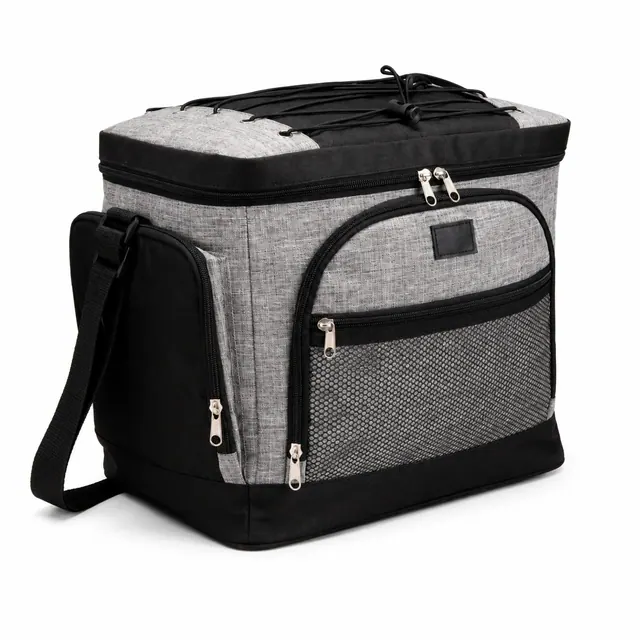
- Adult work and office: a structured, dark or neutral lunch cooler with a shoulder strap. Black lunch bags and two-tone greys sell steadily. Example: the two-tone 600D adult work lunch bag at 34.5 × 24 × 30 cm.
- Kids and school: brighter prints (pink, purple, florals and animal designs), easy zips and a name label panel. Children's products need the right tests for the market, such as EN 71-3 or CPSIA.
- Neoprene lunch bag: stretchy, soft and naturally insulating, with a retail-friendly look. See the neoprene lunch box tote.
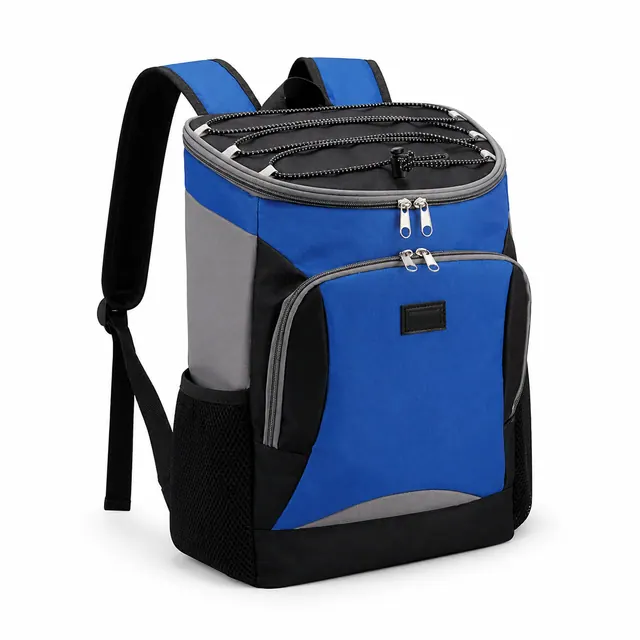
- Lunch bag with backpack: an insulated lunch backpack or a backpack with lunch compartment suits commuters and students; for example, the insulated lunch backpack with bottle pocket.
- Large lunch tote: a wider insulated tote that takes containers flat, for shift workers and families.
A few searches do not fit this category. Paper and brown paper lunch bags are disposable packaging that we do not supply, and the same goes for rigid lunch box containers. A clear lunch bag, as required by some workplaces and stadiums, is a specific PVC or TPU construction: send us the brief if you need one.
Checklist: what to send for an accurate lunch bag quote
The more of this you send with the first email, the closer the first quote will be to the final price:
- Model reference or reference photo, with outer dimensions.
- Outer fabric and colour (stock or Pantone TCX/TPG reference).
- Insulation: foam thickness and liner type (PEVA, TPU, foil), and whether it must be leak-proof.
- Logo artwork in vector format, method, size and position.
- Quantity per colour, and whether you will reorder.
- Market and end user (adults or children), so we can list the tests that apply: REACH, Prop 65, food-contact migration on the liner, EN 71-3 or CPSIA.
- Packing: polybag, hangtag, barcode, units per carton.
- Incoterm and destination port, plus the date the goods must be in your warehouse.
For private-label retail, packaging and barcodes matter as much as the bag; our private-label lunch bag guide covers shelf readiness. When you are ready, request a quote from our export desk.
How well does a wholesale insulated bag keep food cold?
A well-built insulated lunch bag keeps refrigerated food cool for a working day when used with a cold pack, but performance depends on construction rather than looks.
Our published design data: a 10 mm EPE foam wall with a welded leak-proof liner and two gel packs holds refrigerated food below 8 °C for roughly 6–8 hours at 25 °C ambient. Thinner walls, sewn liners and no ice pack shorten that. These are design ranges, not guarantees; we run a timed temperature test on an approved sample on request. If you plan to print hold times on packaging, test the production bag, not just the prototype.
Frequently asked
What is the minimum order for wholesale lunch bags?
From a tooled catalogue model, the minimum is 500 pieces per colour with your logo. A new pattern or a custom-dyed colour starts at 1,000 pieces per colour. Trial runs of 100–300 pieces are sometimes possible on lunch bags at a higher unit price, which suits testing a new design before a full launch.
How much does a custom insulated lunch bag cost wholesale?
It depends on size, foam thickness, liner type, outer fabric, decoration, packaging and quantity, so any single figure would mislead. A stock-colour catalogue model with a one-colour print is the economical end; neoprene, sublimated fabric or a new pattern costs more. Send a spec and quantity for a written quotation within one working day.
What is the best material for an insulated lunch bag?
For most ranges, 600D coated polyester outside, EPE foam in the wall and a welded PEVA or TPU liner inside is a durable, wipe-clean construction. Neoprene suits soft, stretchy styles. For food contact, ask for a migration test report on the liner, issued for your model and market.
Can I mix colours or designs to reach the MOQ?
Only partly. The minimum applies per colour, because each fabric colour and print carries its own material and set-up minimums. You can usually combine sizes or models in one order and one shipment, but each colour of each model needs to reach 500 pieces on catalogue models.
When should I order lunch bags for back-to-school?
Work back from the in-store date. Sampling, production and sea freight together take roughly 60–94 days, before your approval time, customs and inland delivery. Production from July to October also takes about a week longer. For a summer launch, approve samples in spring.