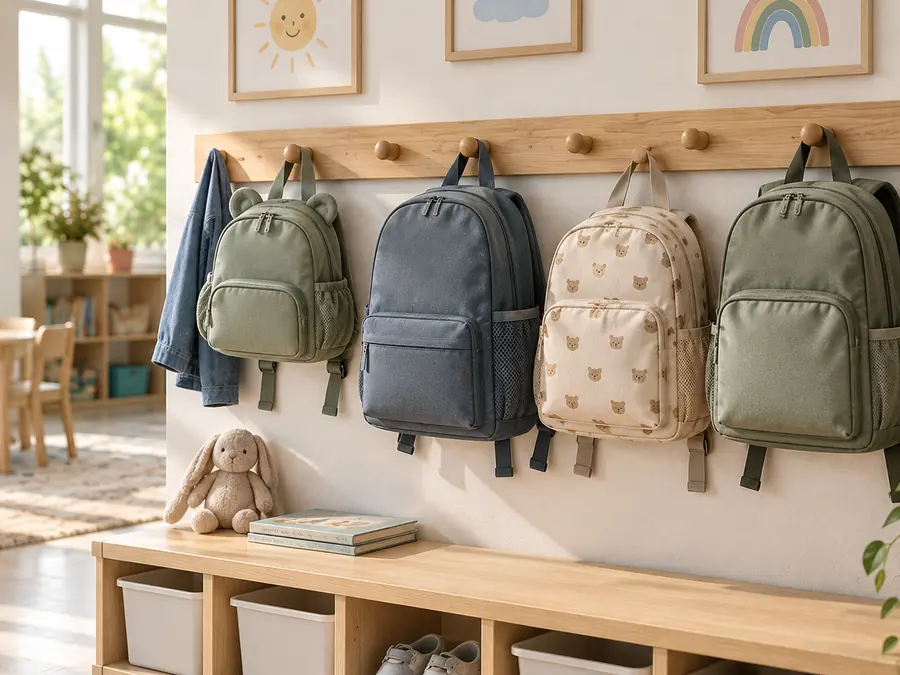
Choose a kids backpack by the child's back, not their age alone: the bag should sit between the shoulders and the waist and be no wider than the torso. As a guide, toddlers suit 25–30 cm bags, primary pupils 38–43 cm and teens 45–48 cm. Look for padded adjustable straps, a light empty weight and reflective trim, and test to EN 71-3 or CPSIA.
Kids backpacks are bought twice: once by the child, who picks the colour or character, and once by the parent, who checks the straps, the size and the price. Whether you came here to shop kids backpacks deals for the new term or to plan a retail range of toddler backpacks, girls backpacks and boys backpacks, the questions are the same. This guide from the Eggroll Bags export desk gives a sizing chart by age, a fit and safety checklist, the tests that apply to children's bags and the practical steps for a back-to-school programme.
What size backpack does my child need?
A child's backpack should run from just below the shoulders to no lower than the waist, and be no wider than the child's torso. Age is a starting point; the child's height and back length decide.
The chart below gives typical dimensions used across the market. Children of the same age vary widely, so retailers often show two sizes per age band and let the parent try them.
| Stage | Typical age | Backpack height | Typical capacity | What it carries |
|---|---|---|---|---|
| Toddler | 2–3 | 25–30 cm | 5–8 L | Spare clothes, snack, nappy pouch |
| Preschool | 3–5 | 30–35 cm | 8–12 L | Lunch bag, drink, a folder |
| Kindergarten and early primary | 5–7 | 35–40 cm | 10–15 L | A4 folder, lunch, water bottle |
| Primary school | 8–11 | 38–43 cm | 15–22 L | Books, pencil case, lunch, PE kit |
| Middle school | 11–14 | 42–46 cm | 18–25 L | Several books, tablet or small laptop |
| High school and teens | 14+ | 45–48 cm | 20–30 L | Laptop, books, sports kit |
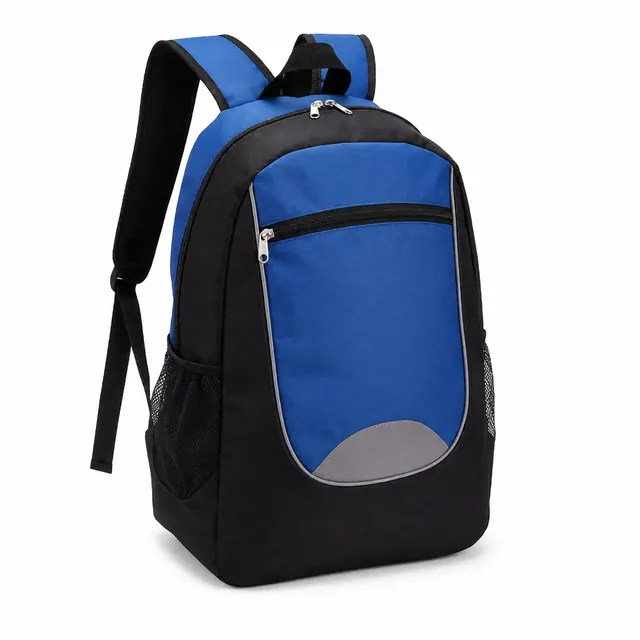
To check a catalogue bag against the chart, multiply its dimensions and divide by 1,000 for an approximate capacity in litres. Our kids school backpack (31.5×16.5×45 cm) works out at about 23 litres, a primary or middle-school size. The printed kids school backpack (30×6.5×41 cm) is a slim format of around 8 litres, suited to preschool and kindergarten children who carry little more than a folder and a snack. For backpacks for teen girls and boys, the teen school and laptop backpack (600D polyester, 31×12×41 cm) gives about 15 litres in a flatter, more grown-up shape.
Toddler and preschool backpacks
A toddler backpack should be small, very light and easy for a small child to put on alone. It is more about independence than capacity.
Little backpacks for nursery and preschool carry a change of clothes, a snack and perhaps a comforter. Key points are a light empty weight, short adjustable straps, a top grab handle for adults, a wide zip opening and a chest strap to stop the straps sliding off narrow shoulders. Character and animal shapes, such as a shark backpack for kids, are popular at this age; a fully shaped bag is a new pattern rather than a print change, so it starts at 1,000 pieces per colour.
For the youngest children, review small parts carefully. Zip pullers, detachable charms, pompoms and patches should be firmly fixed, and some toy-like backpacks may be assessed under toy safety rules. Ask the testing laboratory how the product will be classified before you finalise the design.
Kids backpacks for school: girls, boys and teens
School backpacks need structure and durability, because they are carried every day with books and a lunch inside. The construction matters more than whether the range is labelled for girls or boys.
- Fabric: 600D polyester is the workhorse; 1680D adds abrasion resistance on the base and front. Water-resistant coatings help in wet climates.
- Back panel: padded and slightly shaped so books do not press into the spine.
- Organisation: a main compartment that takes an A4 folder, a front pocket for small items and side pockets for a water bottle.
- Base: reinforced or double-layered, because school bags are dropped on floors all day.
- Laptop or tablet sleeve: expected in middle school and high school backpacks.
Colour and print do most of the work for school bags for girls and school bags for boys; the underlying construction can often be shared, which keeps the range efficient. Our colourful kids school backpack (600D fabric with PVC, 31×19×46 cm) is one example of a structured primary-age bag where the print can be changed season to season. Matching lunch bags and pencil cases turn a single backpack into a set, as in our back-to-school backpacks and lunch kits project.
Kids backpack fit and safety checklist
Use this checklist when comparing samples. It covers fit, comfort and the details that make a backpack easier and more visible to use; it is not a substitute for product testing.
- The bag sits between the shoulder line and the waist when adjusted, and is no wider than the child's torso.
- Both shoulder straps are padded, adjustable and wide enough not to dig in.
- A chest strap is fitted on toddler and preschool sizes, and on larger bags that will be carried loaded.
- The back panel is padded, and heavy items sit in the compartment closest to the back.
- Empty weight is low; a commonly cited guide is that a loaded backpack should stay around 10–20% of the child's body weight.
- Reflective trims or patches are fitted on the front and straps for visibility on dark mornings.
- Zips run smoothly and pullers are large enough for small hands to use.
- Small parts are securely attached and there are no long loose cords.
- The name label sits inside the bag rather than on the outside.
- Strap anchors are stitched and bar-tacked, not glued.
On our side, every order is inspected inline at 20% and 80% of production and again before shipment to ISO 2859-1 General Level II, AQL 2.5 major and 4.0 minor. On-site tests include a 50-cycle zip test, a handle pull at 5 kg for 60 seconds, print rub and carton drop.
Which tests apply to children's backpacks?
Children's backpacks are tested for restricted substances in the materials a child can touch, with the specific reports depending on the market. We describe what testing applies rather than calling a product "safe".
- EN 71-3 for migration of certain elements, commonly requested for children's products in the EU and UK.
- Phthalates in PVC, prints, patches and coated parts.
- CPSIA for US children's products, including lead and phthalate limits, tracking labels and a Children's Product Certificate.
- REACH SVHC for the EU and Prop 65 for California.
Reports are issued per model and per market in the buyer's name. Licensed character backpacks also need the licensor's artwork approval before bulk, so build that step into the timeline.
Personalised and custom backpacks for kids
Custom backpacks for kids can carry your brand, a school crest or an all-over print. Individual name personalisation is usually added after import, close to the customer.
In bulk we decorate with screen print, heat transfer, sublimation, embroidery, woven labels and silicone or PU patches, matched to Pantone references. For personalised toddler backpacks, personalised preschool backpacks and personalised backpacks for kindergarten, many retailers order a bag with a plain embroidery-friendly panel or a name patch area and add the name locally, which keeps each production colour above the minimum.
Planning a back-to-school backpack range
Most retailers selling kids backpacks on sale for the school season place orders months ahead. Work backwards from the date the bags must be in store.
A counter sample takes 7–12 days, with the fee credited against bulk. Bulk takes 25–35 days after sample approval, and July to October adds about a week. Sea freight to North Europe or the US East Coast takes 28–40 days. Add testing and any licence approvals, and a June or July shelf date means briefing in winter. The minimum is 500 pieces per colour on a catalogue model and 1,000 for a new pattern or custom-dyed colour.
Browse our school bags and pencil cases, then send us your range brief for a written reply within one working day.
Frequently asked
What size backpack is right for a kindergarten child?
Most kindergarten children suit a backpack about 35–40 cm tall with roughly 10–15 litres of space, enough for an A4 folder, a lunch bag and a water bottle. Check the fit on the child: the bag should sit below the shoulders, end above the waist and be no wider than their back.
What should I look for in a toddler backpack?
Look for a small, very light bag, around 25–30 cm tall, with short padded straps, a chest strap and a top handle for adults. The zip should be easy for small hands, and charms, patches and pullers must be firmly attached. Avoid long cords and anything that could come loose.
How heavy should a child's backpack be?
A commonly cited guide is that a loaded backpack should weigh no more than about 10–20% of the child's body weight. That makes a light empty bag important. Pack heavy items closest to the back, use both shoulder straps and adjust them so the bag sits high, not hanging below the waist.
What tests do kids backpacks need?
It depends on where they are sold. EU and UK buyers commonly request EN 71-3, phthalate and REACH reports; US buyers need CPSIA compliance, including lead and phthalate limits, tracking labels and a Children's Product Certificate, and Prop 65 for California. Reports should be issued per model and market in the importer's name.
Can I order personalised kids backpacks in bulk?
Bulk orders can carry a logo, school crest or all-over print from 500 pieces per colour on a catalogue model. Names for individual children are usually added after import by embroidery or heat transfer, so many buyers specify a plain panel or a name patch area designed for that purpose.