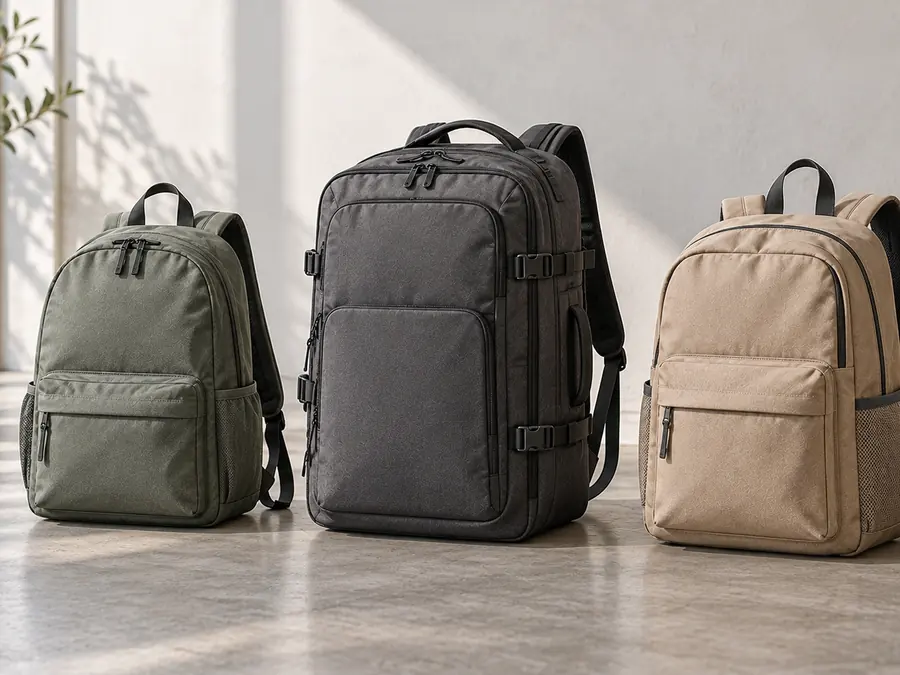
To choose a backpack, start with use and size: about 5–10 litres for a mini backpack, 15–25 litres for a work or school backpack, 20–30 litres for a hiking daypack and 30–45 litres for a carry-on travel backpack. Then check fabric (600D for everyday, 1680D for heavy use), a padded back panel, strap comfort, laptop sleeve size and zips.
Lists of the best backpacks change every season, but the reasons a backpack is good do not. Size, fabric, back panel, straps, zips and pocket layout decide whether a bag is comfortable on day one and still intact in year three. If you understand those six things, you can judge any backpack in a shop in a minute, and if you are a brand, you can write a specification that a factory will build exactly.
This guide from the Eggroll Bags export desk explains how to choose a backpack by use, from a mini backpack to the best travel backpack for carry-on, then turns the same logic into the spec sheet we use when brands develop their own backpacks.
How to choose a backpack: start with use and size
Choose the use first and the size second. A backpack's capacity in litres is the most useful single number, and it follows directly from the use.
You can estimate capacity from the outside dimensions: length × width × height in centimetres, divided by 1,000, gives litres. A 33 × 14.5 × 49 cm backpack is about 23 litres; a 31 × 12 × 41 cm school backpack is about 15 litres. Real usable space is a little less because of padding and pockets.
| Use | Typical capacity | Must-have features | Typical fabric |
|---|---|---|---|
| Mini backpack | 5–10 L | Light weight, phone and wallet pocket, adjustable straps | 600D polyester, nylon, PU or vegan leather |
| Work or commuter backpack | 15–25 L | Padded laptop sleeve, organiser panel, luggage pass-through | 600D–1680D polyester, coated nylon |
| School or college backpack | 15–25 L | Padded straps, bottle pocket, durable base, laptop sleeve for older students | 600D or 1680D polyester |
| Hiking daypack | 20–30 L | Chest strap, ventilated back, bottle pockets, compression straps | Ripstop nylon or 1680D polyester |
| Carry-on travel backpack | 30–45 L | Clamshell opening, hip belt or stowable straps, lockable zips | 1680D polyester or heavy coated nylon |
What makes the best travel backpack
The best travel backpack is the largest bag your airline accepts as cabin baggage that still carries comfortably when full. Cabin limits differ by airline; many sit around 55 × 40 × 20 cm, which works out at about 44 litres, so check the carrier before you buy.
For travel, look for a clamshell (suitcase-style) opening so you can pack flat, a padded hip belt to move weight off the shoulders, straps that tuck away for check-in or overhead lockers, lockable zip pullers and a separate laptop compartment for security screening. A best carry-on backpack is also a sensible shape: a squared-off body packs more efficiently than a tapered one.
Budget travel backpacks usually save money on the frame, hip belt and zips, not on the fabric you see. Those are exactly the parts that fail when the bag is full.
Choosing a work backpack or commuter backpack
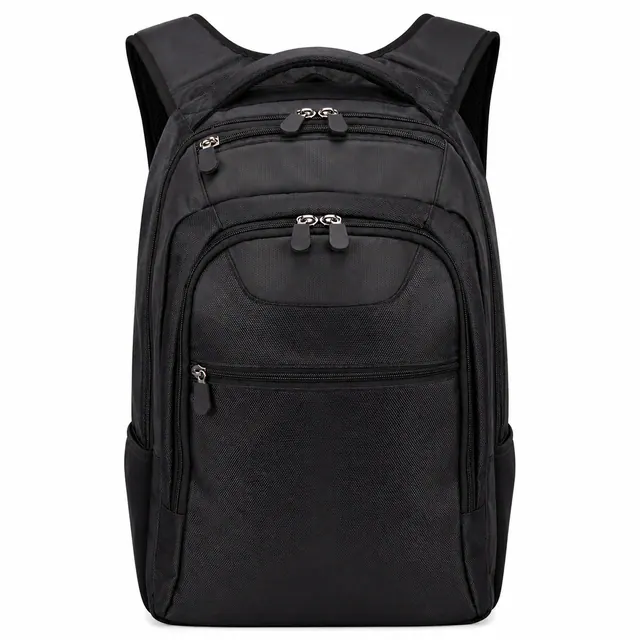
A good work backpack protects a laptop, looks tidy in a meeting and carries comfortably for an hour on foot or on a train. That usually means 15 to 25 litres, a padded sleeve that suspends the laptop above the base, and a clean front with hidden pockets.
- Laptop sleeve: measure the laptop, not the screen size, and allow 1–2 cm extra. Sleeves are often sized for 13, 14, 15.6 or 16 inch machines.
- Weather: most "waterproof" commuter backpacks are water-resistant: coated fabric and covered zips shed rain, but only welded seams or a roll-top keep water out entirely.
- Back panel: padded foam with air channels reduces a sweaty back on warm commutes.
- Luggage pass-through: a strap on the back panel lets the bag sit on a suitcase handle for business trips.
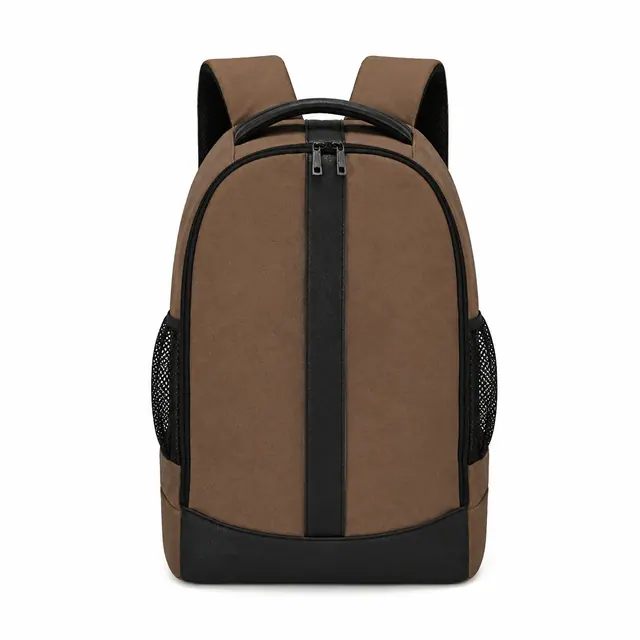
Our camera and laptop backpack (canvas and PU, 32 × 15 × 47 cm) and the teen school and laptop backpack (600D, 31 × 12 × 41 cm) are two catalogue starting points for this category.
Mini backpacks, cute backpacks and black backpacks
Style-led backpacks still need to be built properly. The design decisions are mostly about proportion, colour and finish, but the strap anchors and zips carry the same loads as on any bag.
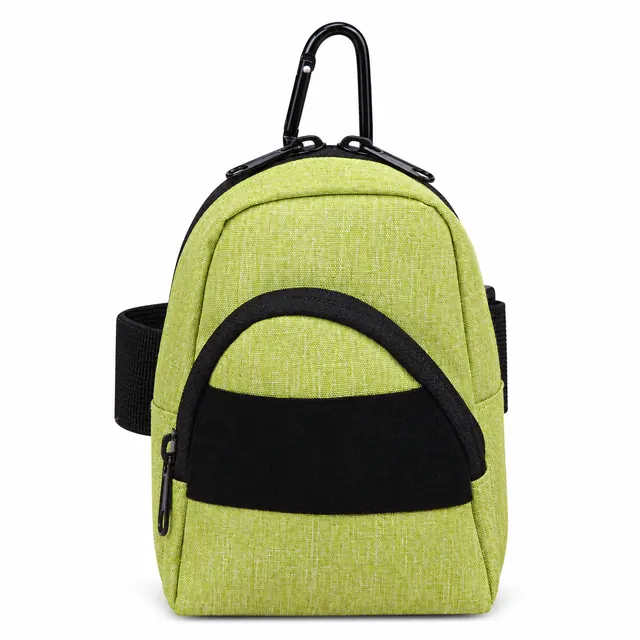
A mini backpack holds roughly 5–10 litres: phone, wallet, keys, a small bottle and perhaps a tablet. Check that straps adjust short enough for a small frame and that the top handle is stitched through to a reinforcement, not just to the outer fabric. For a still smaller carry, our compact mini sport arm bag (600D, 10 × 6 × 15 cm) takes just a phone and keys.
Cute backpacks rely on print and trims: all-over sublimated patterns, pastel colourways, embroidered motifs, silicone or PU patches and contrast zip pullers. Sublimation works on polyester and keeps the colour inside the fibre, so it does not crack.
A black backpack is the year-round best seller because it hides dirt and suits work, school and travel. The difficulty is consistency: black dyes vary from batch to batch, and black fabric, webbing and zip tape from different suppliers rarely match exactly. Specify a Pantone reference and approve a lab dip for each component.
Clear backpacks, required at some stadiums and schools, are a separate construction in transparent PVC or TPU. We do not list a clear backpack model; send a brief if you need one developed.
Hiking and camping backpacks
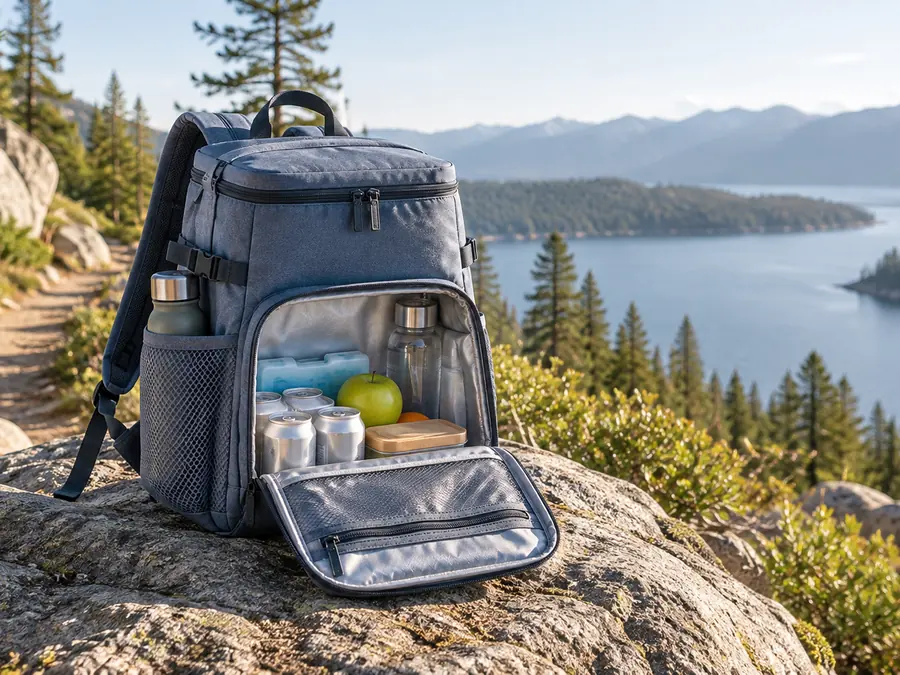
For a day hike, 20–30 litres is enough for water, layers, food and a first-aid kit. Comfort depends on a chest strap that stops shoulder straps sliding outwards, a ventilated back panel, side pockets you can reach while walking and compression straps to stop a half-empty bag from swinging. Multi-day trekking packs with internal frames and load-lifter straps are a specialist category beyond what most lifestyle brands need.
Our custom 1680D hiking backpack (33 × 14.5 × 49 cm, about 23 litres) is a daypack-sized base model.
Backpack fabrics compared
Fabric decides durability and price more than any other component. Denier (D) is the thickness of the yarn; higher denier usually means a heavier, more abrasion-resistant fabric.
| Fabric | Feel | Strengths | Best for |
|---|---|---|---|
| 600D polyester | Light, smooth | Economical, prints well | School, promotional, mini backpacks |
| 1680D polyester | Heavy, slightly glossy | High abrasion resistance, holds shape | Travel, work, hiking, durable backpacks |
| RPET 600D | Similar to 600D | Recycled content, supported by a GRS transaction certificate | Sustainability-led ranges; typically 8–15% more than virgin 600D |
| Canvas with PU trim | Natural, matte | Classic look, ages well | Lifestyle, camera and laptop bags |
| PU or vegan leather | Smooth, structured | Premium look in small sizes | Mini and fashion backpacks |
Our bag fabric guide covers these in more detail.
The backpack spec sheet brands use
For a brand, choosing a backpack means writing it down so precisely that two factories would build the same bag. A complete spec sheet covers these points:
- Use, target user and target retail price
- Outside dimensions and capacity in litres, with tolerance
- Shell fabric, denier, coating and colour (Pantone TCX or TPG)
- Lining, foam thickness for back panel and straps, laptop sleeve size
- Webbing width and colour, buckles, zip size and pullers
- Pocket map: every pocket with position and closure
- Decoration: method, logo size and position, Pantone C for print
- Labels, hang tag, polybag, carton marks
- Required tests and market reports, such as REACH, Proposition 65 or, for children's school backpacks, EN 71-3 or CPSIA
- Quantity per colour and target ship date
On site we test zips for 50 cycles, pull handles at 5 kg for 60 seconds and rub-test the print, then inspect bulk to ISO 2859-1 General Level II at AQL 2.5 major and 4.0 minor. Catalogue backpacks start at 500 pieces per colour, or 1,000 per colour for a new pattern. Our travel and work carry range project shows a line built on one shared hardware platform. Send your spec sheet, or just the use and quantity, through the quote request form.
Frequently asked
What size backpack do I need?
Match size to use. A mini backpack holds about 5–10 litres, a work, school or college backpack 15–25 litres, a hiking daypack 20–30 litres and a carry-on travel backpack 30–45 litres. To estimate a bag's capacity, multiply its outside length, width and height in centimetres and divide by 1,000; usable space is slightly less.
What is the best travel backpack for carry-on?
The best carry-on backpack is the largest your airline allows in the cabin that still carries comfortably. Many cabin limits are around 55 × 40 × 20 cm, about 44 litres, but they vary, so check first. Look for a clamshell opening, a padded hip belt, stowable straps, lockable zips and a separate laptop compartment.
What makes a backpack durable?
Durability comes from heavier fabric such as 1680D polyester or coated nylon, a reinforced base, bar-tacked strap anchors, quality zips of an appropriate size and seams finished with binding. Check where the shoulder straps meet the body: if they are stitched only to the outer fabric, that is where the bag will fail first.
Are waterproof backpacks really waterproof?
Most are water-resistant rather than waterproof. Coated fabric and covered zips shed rain on a commute, but water can still enter through stitch holes and zip teeth in heavy rain. A truly waterproof backpack needs welded or taped seams and a roll-top or waterproof zip, which is a different and more costly construction.
What is a good work backpack size for a laptop?
Most work backpacks sit between 15 and 25 litres. Measure the laptop itself and choose a sleeve 1–2 cm larger, ideally one that is padded and suspended above the base so the laptop is protected when the bag is put down. A front organiser panel and a luggage pass-through strap help on business trips.